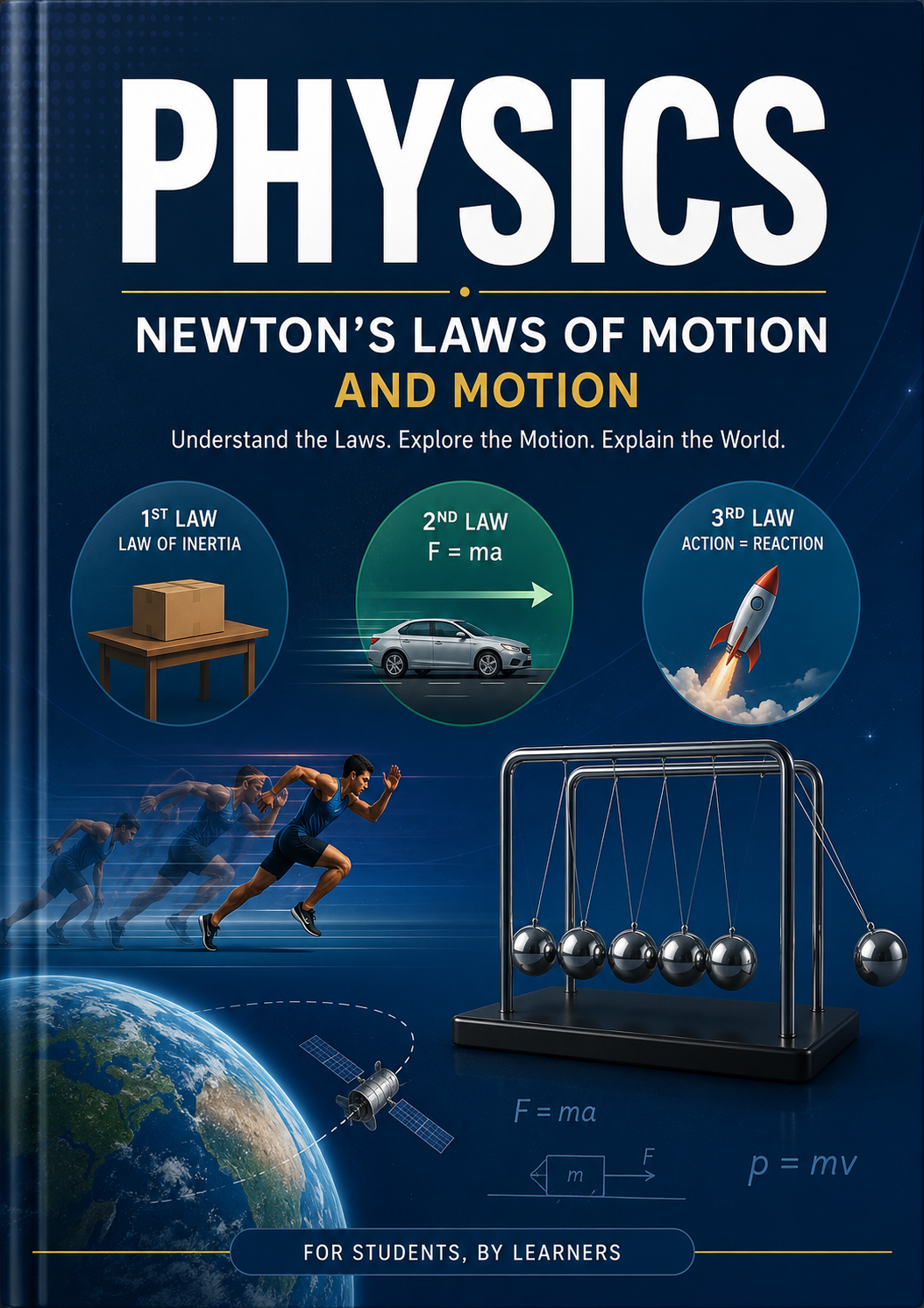
About This Book
Newton's Laws of Motion and Motion
What is Motion?
Motion is the change in the position of an object with respect to time. Everything around us that moves, such as cars, bicycles, planets, and people, is in motion.
Types of Motion
Linear Motion – Movement in a straight line.
- Example: A train moving on a straight track.
Circular Motion – Movement along a circular path.
- Example: A fan rotating.
Periodic Motion – Motion that repeats at regular intervals.
- Example: A swinging pendulum.
Newton's Laws of Motion
1. Newton's First Law of Motion (Law of Inertia)
Statement: An object remains at rest or continues to move with uniform velocity in a straight line unless acted upon by an external unbalanced force.
Examples
- A book on a table remains at rest until someone moves it.
- Passengers move forward when a moving bus stops suddenly.
Inertia
Inertia is the property of an object that resists any change in its state of motion or rest.
2. Newton's Second Law of Motion
Statement: The rate of change of momentum of an object is directly proportional to the applied force and occurs in the direction of that force.
Mathematical Form
v = u + at
The force acting on an object is given by:
F = ma
Where:
- F = Force (Newton, N)
- m = Mass (kg)
- a = Acceleration (m/s²)
Examples
- A football moves farther when kicked harder.
- An empty shopping cart accelerates more easily than a loaded one.
Applications
- Designing vehicles
- Rocket launches
- Sports activities
3. Newton's Third Law of Motion
Statement: For every action, there is an equal and opposite reaction.
Examples
- Walking: Your feet push the ground backward, and the ground pushes you forward.
- Swimming: Swimmers push water backward to move forward.
- Rocket propulsion: Exhaust gases move backward, pushing the rocket forward.
Important Quantities in Motion
Distance
The total path covered by an object.
Formula
Distance = Speed × Time
Displacement
The shortest distance between the initial and final positions, including direction.
Speed
Distance traveled per unit time.
Formula
Speed = Distance / Time
Unit: m/s
Velocity
Displacement per unit time in a specific direction.
Formula
v = u + at
Unit: m/s
Acceleration
Rate of change of velocity.
Formula
Acceleration = (Final Velocity − Initial Velocity) / Time
Unit: m/s²
Momentum
Momentum is the quantity of motion possessed by an object.
genui{"physics_learning_block":{"type_id":"MOMENTUM"}}
Where:
- p = Momentum
- m = Mass
- v = Velocity
Example
A fast-moving truck has more momentum than a slow-moving bicycle.
Real-Life Applications of Newton's Laws
- Seat belts protect passengers during sudden stops.
- Rockets move according to Newton's third law.
- Sports such as cricket, football, and tennis involve force and momentum.
- Vehicles accelerate and brake based on Newton's second law.
- Walking and running are examples of action and reaction forces.
Conclusion
Newton's Laws of Motion explain how objects move and interact with forces. The first law describes inertia, the second law relates force to acceleration, and the third law explains action-reaction pairs. These laws form the foundation of classical mechanics and help us understand everyday motion as well as advanced engineering and space science.